
Published: 9 September 2026 | Last reviewed: 5 September 2026
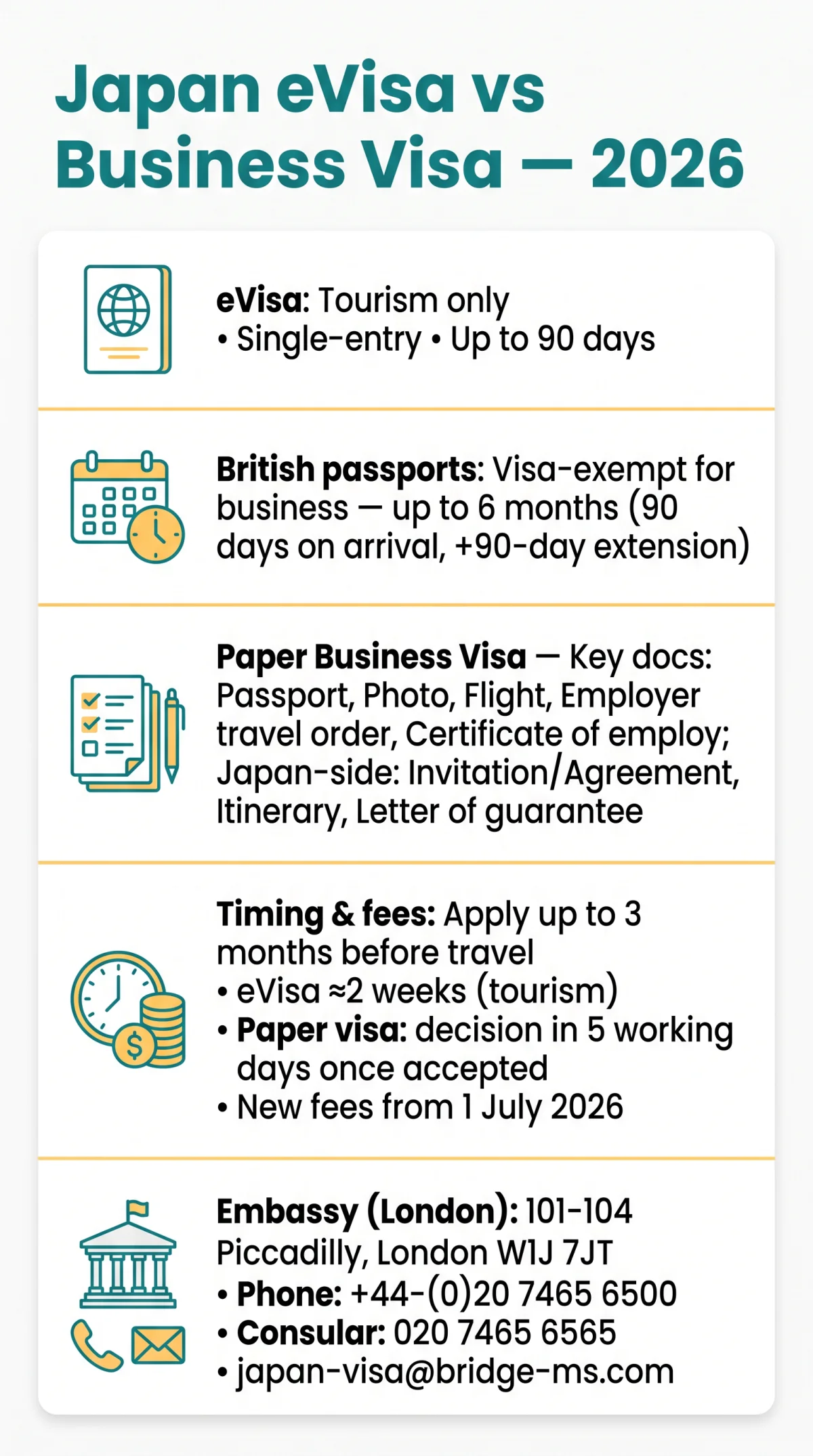
The Japan eVisa is tourism-only; business travellers cannot use it. UK citizens are visa-exempt for business stays up to 6 months. Non-exempt nationals must apply for a paper business visa with an invitation letter, employer documentation, and itinerary at the Embassy of Japan in London.
Japan eVisa for Business: Who Needs One and Who Doesn’t
The Japan eVisa is restricted to single-entry tourism (up to 90 days, ordinary passport required). Business travel is excluded. British passport holders need neither an eVisa nor a paper visa for short-term business stays up to 6 months.
- British passport holder – visa-exempt for business up to 6 months; initial 90 days granted on arrival, extendable by a further 90 days at an immigration office in Japan.
- British Overseas Citizen / British Subject / British Overseas Territories Citizen – must obtain a paper business visa before travel; eVisa is not available for business.
- Non-British UK resident – check visa exemption for your nationality; if not exempt, apply for a paper business visa. Multiple-entry business visas are available for nationals of India, Vietnam, Indonesia, and the Philippines.
- Non-resident in the UK – applications cannot be accepted at the UK embassy; apply in your country of residence.
Non-exempt travellers submit paper applications at the Embassy of Japan in London (101-104 Piccadilly, London W1J 7JT) or the Consulate-General in Edinburgh. In-person appointments are mandatory. COE is not required for short-term business stays under 90 days. Source: Ministry of Foreign Affairs of Japan (mofa.go.jp).
Business Travel: Why eVisa Won’t Work and What You Must Do Instead
The Japan eVisa system excludes all business travel. Non-exempt nationals must follow these steps:
Gather documents
Gather documents from your UK employer and Japanese partner.
Book an in-person appointment
Book an in-person appointment at the Embassy of Japan in London (phone: +44-(0)20 7465 6500; Consular Section: 020 7465 6565) or the Consulate-General in Edinburgh (jurisdiction: Scotland and North of England).
Submit your application
Submit your application in person or via a registered visa agent. Agents cannot be used for Student, Working Holiday, or Spouse/Child of Japanese National visas.
Receive a decision
Receive a decision in 5 working days once the application is accepted as valid.
Apply up to 3 months before departure
Apply up to 3 months before your departure date.
The Visa Information Hotline (0844-986-4968, 24/7, English) and email ([email protected]) are available for inquiries. A Certificate of Eligibility (COE) is only needed for work or long-term stays exceeding 90 days, not for short-term business visits.
Tourism eVisa vs Business Visa: Side-by-Side Comparison
The Japan eVisa requirements for business and tourism differ in documentation, financial proof, and processing. The table below contrasts every key criterion.
| Criterion | Tourism eVisa | Business Paper Visa |
|---|---|---|
| Application channel | 100% online (JAPAN eVISA website) | In-person at Embassy/Consulate or via registered agent |
| Visa format | Electronic (visa issuance notice on digital device) | Sticker in passport |
| Required documents (applicant) | Passport, application form, photo, flight itinerary, bank statement, itinerary in Japan | Passport, application form, photo, flight itinerary, employer travel order + certificate of employment |
| Required documents (Japan side) | None (self-arranged accommodation) | Invitation letter (or transaction agreement or conference materials) + itinerary + letter of guarantee |
| Financial proof | Applicant’s bank statement (most recent 1 month) – ~80% of rejections if missing | Shifts to Japanese guarantor’s corporation register + guarantee letter; applicant’s proof optional if company covers expenses |
| Processing time (UK) | Normally 2 weeks on average | 5 working days (once accepted) |
| Maximum stay | Up to 90 days | Up to 90 days |
| Fees | Paid online by credit/debit card | Varies by nationality; new fee schedule effective 1 July 2026 |
| Airport proof | Digital display only – printed copy NOT accepted | Visa sticker in passport serves as boarding proof |
Business Travel Scope: Activities Allowed, Prohibited, and Financial Proof
Short-term business visas permit meetings and conferences but prohibit paid work. The Japan eVisa, by contrast, handles only tourism applications electronically.
| Activity | Allowed? | Notes |
|---|---|---|
| Business meetings | Yes | Core permitted purpose |
| Conferences and seminars | Yes | Including academic exchange |
| Trade fairs and exhibitions | Yes | Including negotiating contracts |
| Factory/site inspections | Yes | Observation only |
| Sports exchange | Yes | Specifically listed by MOFA |
| Paid consulting or workshops | No | Requires work visa + COE |
| Hands-on assembly/installation | No | Requires work visa + COE |
| On-site assignments >90 days | No | Requires long-term visa + COE |
| Receiving remuneration in Japan | No | Prohibited on short-term stay |
Financial proof: eVISA requires the applicant’s own bank statement (most recent 1 month; missing it causes ~80% of rejections, per US embassy data). Business paper visa shifts proof to the Japanese guarantor’s corporation register and guarantee letter. For unregistered guarantor companies, an overview of company/organization is required instead. Companies listed on a stock exchange submitting quarterly corporate reports are exempt from providing the corporation register.
Complete Document Checklist for Japan Short-Term Business Visa
Business visa applicants need dual-track documentation. The Japan eVisa requirements for business exclude electronic applications, requiring a paper application with dual-track documentation instead.
Track A – Your UK Employer: A travel order issued by employer (or employer letter or equivalent document), plus a certificate of employment.
Track B – Your Japanese Partner: An invitation letter (or transaction agreement or conference materials), itinerary in Japan, and a letter of guarantee if the partner covers expenses. The Japanese organisation must send these documents directly to the applicant, not to the Embassy or MOFA.
All documents must be issued within the last 3 months. Company seals are no longer required on invitation or guarantee letters. Copies are accepted; originals may be requested for detailed confirmation.
Employer Documentation: The Document Business Travellers Overlook
Many applicants focus on Japanese-side documents and forget their own employer’s contribution. You need either a travel order, a letter from your employer confirming the business purpose, or an equivalent document, plus a certificate of employment. Source: mofa.go.jp.
How Your Japanese Business Partner Should Prepare Documents
The inviting organisation in Japan must send all required documents directly to you, the applicant, not to MOFA or the Embassy. MOFA recommends they make copies before sending. PDF-format templates are available from the MOFA website.
Language and Translation Rules for Business Documents
Documents in Japanese or English are accepted without translation. Documents in other languages require certified (sworn) translation. Passport must be valid for at least 6 months with 1.5 blank pages. Photo specifications: 2 x 2 inches, plain white background, taken within the past 6 months, no filters.
Application Process, Timeline, and Fees in 2026
Tourism eVisa: normally 2 weeks on average. Paper business visa: 5 working days at UK Embassy once accepted. Both can be submitted up to 3 months before departure.
- eVisa (tourism only): Apply online, fee notice by 5th business day, pay by card, display digitally at check-in. Printed copies NOT accepted.
- Paper business visa: Prepare documents, book an in-person appointment at the Embassy of Japan in London, submit, and receive a decision in 5 working days.
- New visa fee schedule effective 1 July 2026; amounts vary by nationality. No fees charged unless the visa is issued.
A visa does not guarantee entry into Japan. The immigration officer at the port of entry grants landing permission. MOFA highly recommends purchasing international travel medical insurance. In Japan, the FRESC MOFA Visa Information centre (Yotsuya Tower 13F, 1-6-1 Yotsuya, Shinjuku-ku, Tokyo) provides visa support Monday to Friday, 09:00-17:00 (phone: 0570-011000).
Common Mistakes to Avoid When Applying for a Japan eVisa or Business Visa
- eVisa: missing bank statement (causes ~80% of rejections, per US embassy data).
- eVisa: submitting a printed visa issuance notice at the airport (must be digital).
- Business: forgetting the employer travel order or certificate of employment.
- Business: documents older than 3 months at time of submission.
- Business: inviting organisation sending documents to the Embassy instead of to the applicant.
- Using fraudulent websites mimicking the JAPAN eVISA portal. The genuine site displays “Ministry of Foreign Affairs of Japan” on the top left.
Frequently Asked Questions
Can British citizens travel to Japan for business without a visa?
Yes. British passport holders: visa-exempt for business stays under 6 months. 90 days on arrival, extendable by 90 days at an immigration office. No eVisa or paper visa needed.
Is the Japan eVisa available for business travel?
No. The Japan eVisa system is restricted to tourism purposes only (single-entry, up to 90 days). Business travel, conferences, study, visiting relatives, and transit all require a traditional paper visa application at the Embassy of Japan in London or Edinburgh.
What is an invitation letter for a Japan business visa?
A document from the inviting Japanese organisation (company, conference organiser, or government body) addressed to the Ambassador or Consul General, detailing planned business activities. Available in PDF template from MOFA. Company seal is no longer required.
Can you combine business meetings with sightseeing on a short-term business visa?
Yes. Incidental tourism activities are permissible on a short-term stay visa for business purposes, as long as no remunerative activities occur. No separate tourist visa is needed for side trips during a business visit.
How long is a Japan business visa sticker valid after issuance?
The visa sticker allows entry within 90 days of issuance. Once you enter Japan, you are granted a stay of up to 90 days as indicated in your landing permission.
What is the difference between a short-term business visa and a work permit?
A short-term business visa covers meetings, conferences, trade fairs, inspections, and negotiations. A work permit (requiring a Certificate of Eligibility) is needed for paid work, hands-on technical labour, or stays exceeding 90 days.
How long does it take to process a Japan business visa from the UK?
5 working days at the Embassy of Japan in London once the application is accepted as valid. Using a registered visa agent may add logistics time. The eVisa (tourism only) takes normally 2 weeks on average.
What are the visa fees for UK-based applicants in 2026?
Fees depend on your nationality and the visa type. A new fee schedule took effect on 1 July 2026. The Embassy of Japan in the UK does not charge fees unless the visa is issued. Check the embassy website for current amounts.
Disclaimer: Visa regulations change without notice. This article was fact-checked against data from the Ministry of Foreign Affairs of Japan (mofa.go.jp) and the Embassy of Japan in the UK (uk.emb-japan.go.jp) in September 2026. Always verify with the Embassy of Japan in London before applying.