
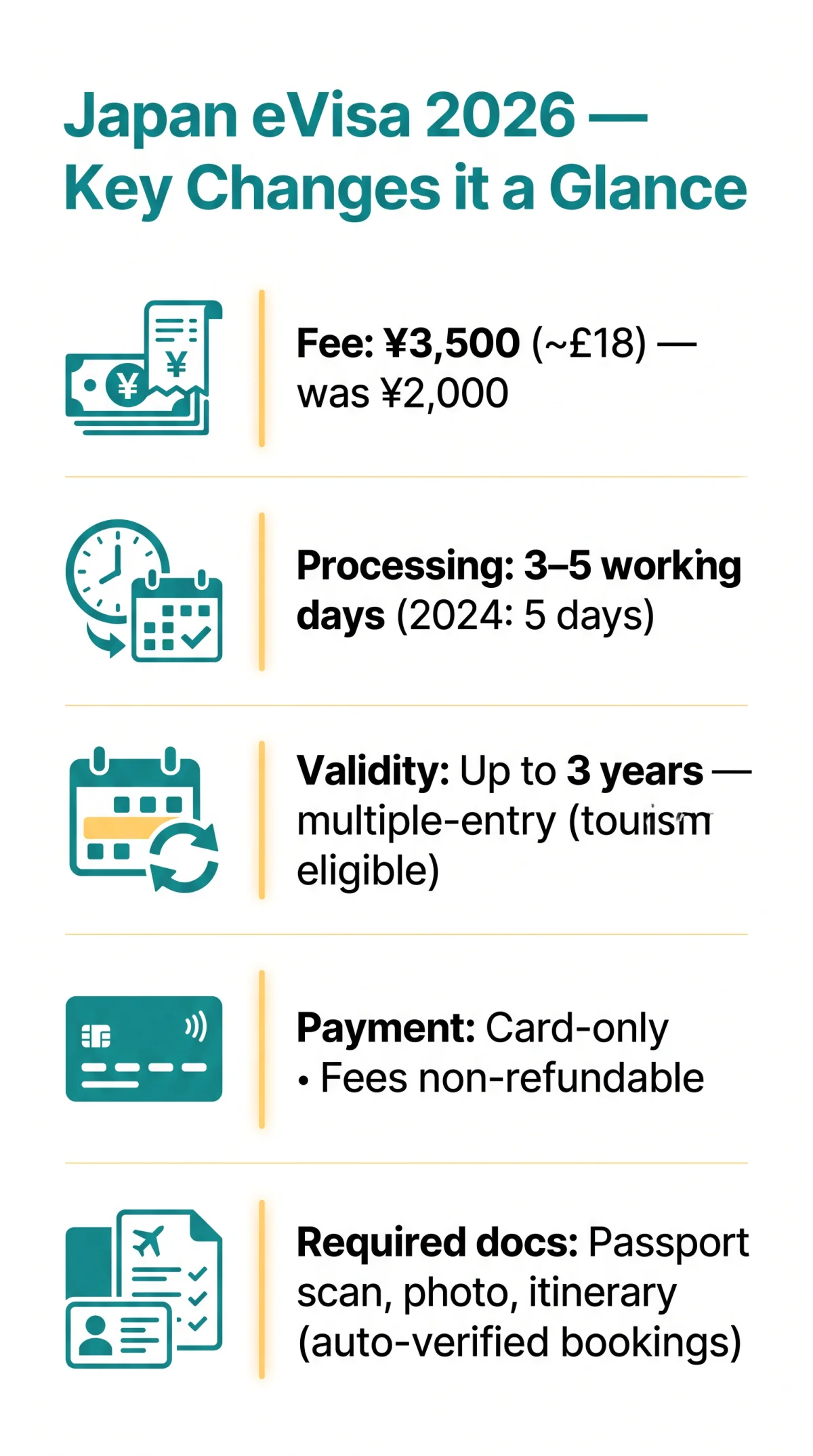
The Japan eVisa system received significant updates in 2026, including expanded eligibility, revised fees from ¥2,000 to ¥3,500 (~£18), and a streamlined application portal with auto-verification of bookings via partner APIs. Compared to 2024, UK travellers now face different requirements and faster 3-5 working day processing times.
This guide covers the key Japan e visa 2026 vs 2024 differences: fee increase from ¥2,000 to ¥3,500, reduced processing to 3-5 working days, auto-verification of bookings, card-only payments, and an in-app status tracker.
Published: September 2026. Last reviewed: September 2026. This article reflects the latest Japan eVisa rules as announced by the Ministry of Foreign Affairs of Japan. Changes after this date may apply. Always check the official Japan eVisa portal before applying.
What Changed in the Japan eVisa System in 2026
The 2026 update introduced a modernised portal, broader country coverage, stricter document verification, and an expanded list of eligible nationalities. Any UK traveler weighing Japan e visa 2026 vs 2024 will find that the upgraded platform now validates biographic data more thoroughly, cross-referencing submitted details against immigration databases before any decision is issued. A request can be rejected because it is considered high risk during automated screening.
The system introduces a choice between single-entry and multiple-entry options, while photo and document upload rules are now stricter, with automated validation rejecting submissions that fail to meet the new digital standards. Japan eVisa 2026 expands eligibility from the initial pilot list (2024) to include additional nationalities, and adds a business-visit category for UK passport holders.
Japan eVisa 2026 vs 2024: Application Process Differences
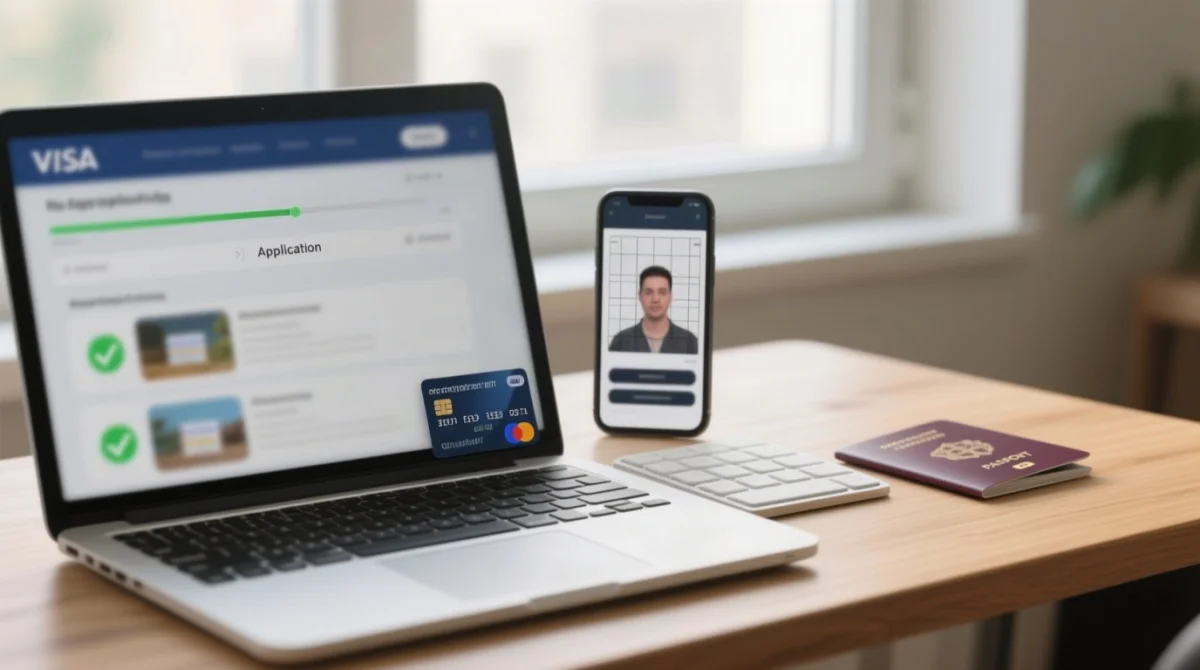
The 2026 application flow is shorter, more digital, and requires fewer manual uploads than the 2024 version.
Account creation
Japan eVisa 2026 retains the online account requirement introduced in 2024 but streamlines the registration with fewer form fields to complete.
Document submission
In 2024, applicants had to upload PDF copies of flight and hotel bookings. Japan eVisa 2026 now auto-verifies some bookings via partner APIs, removing the need for manual uploads in qualifying cases.
Photo upload specs
The digital photo standards carry over from 2024, with the system validating image dimensions and format at the submission stage.
Payment method
Japan eVisa 2026 accepts card payments only, eliminating the bank transfer option that was available under the 2024 process.
Status tracking
The 2024 system relied on email-only notifications for application updates. Japan eVisa 2026 introduces an in-app status tracker, letting applicants monitor progress directly within the portal.
New Eligible Countries and Updated Requirements in 2026
| Feature | 2024 eVisa | 2026 eVisa |
|---|---|---|
| Eligible nationalities | Initial pilot list | Expanded to additional nationalities |
| UK passport holder requirements | Tourist visits only | Tourist + business-visit category added |
| Required documents | Passport scan, photo | Passport scan, photo, itinerary |
| Validity period | 90 days, single entry | Multiple-entry option for tourism |
| Application fee | ¥2,000 | ¥3,500 (~£18) |
| Processing time | 5 business days | 3-5 working days |
Fees, Processing Times, and Validity in 2026
Japan eVisa 2026 adjusts the fee structure and shortens processing times for UK applicants, with new validity options unavailable in 2024. In any Japan e visa 2026 vs 2024 comparison, three areas show clear changes.
| Feature | 2024 | 2026 |
|---|---|---|
| Processing time | 5 working days | 3-5 working days |
| Visa validity | 90 days, single entry | Up to 3 years, multiple entry (eligible tourism applicants) |
| Fee refund policy | Non-refundable | Non-refundable, even if rejected |
FAQ: Japan eVisa 2026 Updates
Is the Japan eVisa available for UK citizens in 2026?
Yes, the 2026 updates include UK citizens in the expanded eligibility list, with a new business-visit category added alongside tourism.
How long does Japan eVisa processing take in 2026 compared to 2024?
Processing times have been reduced to 3-5 working days, down from 5 working days in 2024.
What documents do I need for a Japan eVisa in 2026?
Required documents include a passport scan, photo, and itinerary. Some flight and hotel bookings are now auto-verified via partner APIs, removing the need for manual PDF uploads in qualifying cases.
Can I get a multiple-entry Japan eVisa in 2026?
A multiple-entry option is now available for eligible tourism applicants, with validity up to 3 years.
How much does the Japan eVisa cost in 2026?
The fee is ¥3,500 (~£18), up from ¥2,000 in 2024. Fees are non-refundable even if the application is rejected. Card payments only are accepted.
Can I enter Japan with only an eVisa approval on my phone?
Check the official Japan eVisa portal and your airline for current entry requirements and accepted presentation methods before travelling.
What happens if my Japan eVisa application is rejected in 2026?
A request can be rejected because it is considered high risk during automated screening. Rejected applications receive no fee refund. Consult the official Japan eVisa portal for guidance on reapplying or correcting errors.
Is the 2024 Japan eVisa still valid if I applied last year?
Check the official Japan eVisa portal to confirm if your 2024 eVisa is still valid, as system rules have changed under the 2026 framework.