
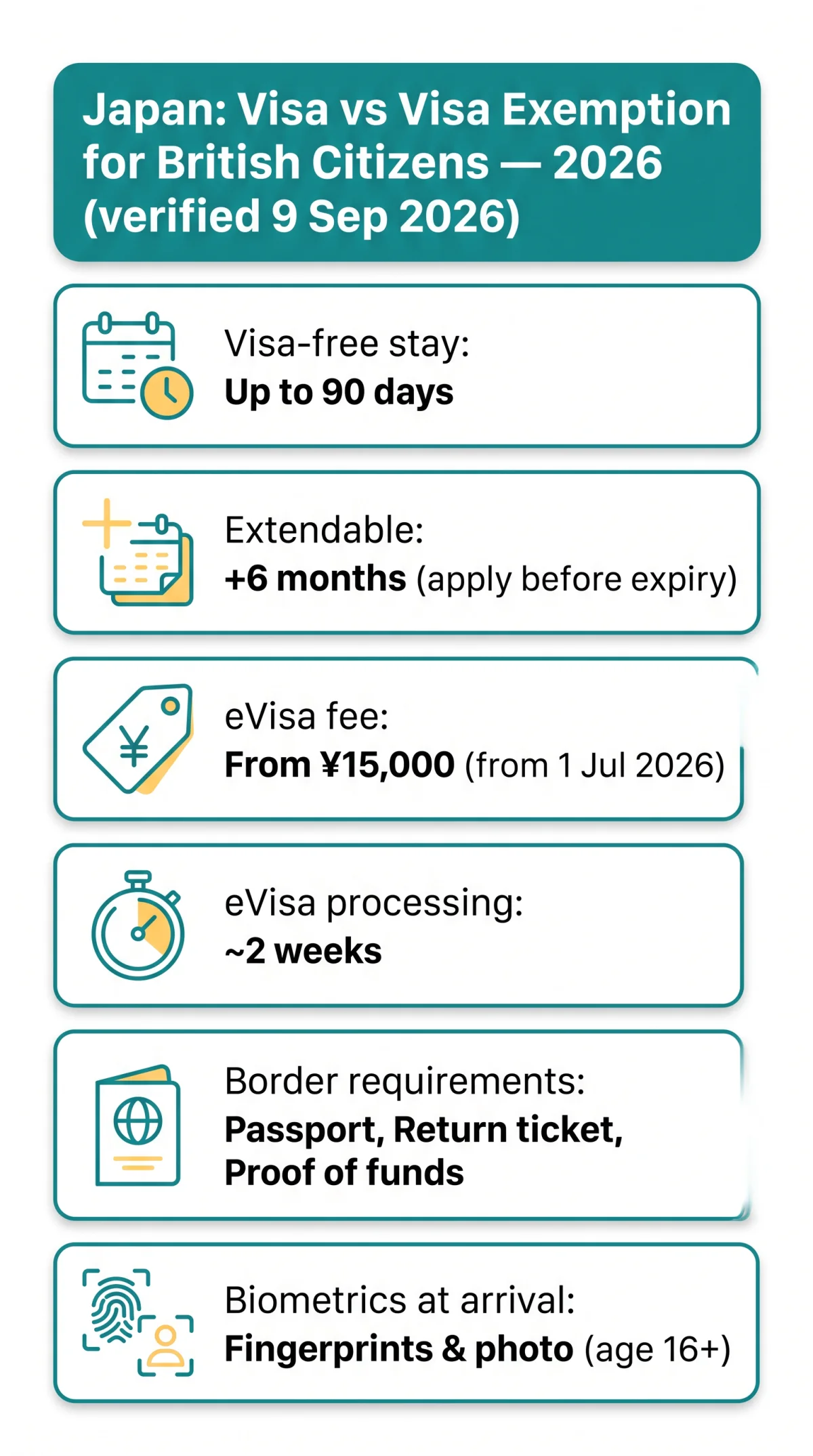
British citizens holding a standard British Citizen passport are visa-exempt for Japan and do not need an eVisa for short stays. Most British travellers can stay up to 90 days for free under the visa waiver. This guide was last verified on 9 September 2026 against the Japanese Ministry of Foreign Affairs (MOFA) visa-exemption page and the UK FCDO travel advice for Japan. This website is not affiliated with MOFA, the Japanese government, or any visa-issuing authority.
Do British Citizens Need a Visa for Japan in 2026?
The Japan e visa vs visa exemption distinction for British citizens is based entirely on your passport type, not your UK residence status. Japan maintains reciprocal visa exemption arrangements with 74 countries and regions, including the United Kingdom. British Citizens with ordinary passports are visa-exempt for short-term stays of up to 90 days; other British passport categories must obtain a visa prior to travel. Details are available on the MOFA website at mofa.go.jp.
British Passport Types – Who Is Exempt and Who Is Not
| Passport Type | Visa-Exempt? | Action Required |
|---|---|---|
| British Citizen (ordinary passport) | YES | No visa needed for stays up to 90 days |
| British National (Overseas) / BNO | YES (conditional) | Exempt only with right of abode in Hong Kong; 90 days |
| British Overseas Citizen (BOC) | NO | Must obtain a visa prior to travel |
| British Subject | NO | Must obtain a visa prior to travel |
| British Overseas Territories Citizen | NO | Must obtain a visa prior to travel (even if passport states ‘BRITISH CITIZEN’) |
| Convention Travel Document holder | NO | Must obtain a visa prior to travel |
Visa Exemption for British Citizens – Conditions, Documents, and Duration
Visa-exempt British citizens can stay in Japan for up to 90 days for tourism, short-term business, or study, completely free. Upon arrival, British citizens receive Temporary Visitor status, which also determines Japan Rail Pass eligibility. Your ICAO-compliant ePassport must be valid for the entire duration of your intended stay; no 6-month buffer is required.
Required at the border for British citizens: a valid British Citizen passport, proof of a return or onward ticket, and sufficient funds (no official minimum; officers may ask for bank cards or statements). Register your CIQ details via Visit Japan Web before arrival. Note: delivery slips can no longer be used for tax-free shopping in Japan.
Permitted unpaid business activities for British citizens: meetings, conferences, market research, and lectures. Not permitted: employment, paid consultancy, or recurring business operations. Travel and medical insurance is not legally mandated, but the UK FCDO strongly recommends comprehensive coverage.
Can British Citizens Stay Longer Than 90 Days?
British citizens can extend their visa-free stay by up to 6 months beyond the initial 90 days, alongside nationals of Austria, Germany, Ireland, Liechtenstein, Mexico, and Switzerland. Apply at a Regional Immigration Bureau (Ministry of Justice) in Japan before your 90-day Temporary Visitor status expires.
Apply at the Bureau
Visit a Regional Immigration Bureau before your 90-day status expires
Submit documents
Provide all required documents for the extension
Pay the fee
Pay the processing fee for your application
Receive decision
Get a decision granting the extension of stay
Japan eVisa for British Citizens – When and How to Apply
British citizens are NOT required to obtain a Japan eVisa. The JAPAN eVISA system serves only nationals of non-exempt countries residing in designated Group 1 or Group 2 regions. The Japan digital visa (eVisa) and the visa exemption are two distinct pathways, as explained in our eVisa vs regular visa comparison.
The eVisa is a single-entry short-term stay visa for tourism only, permitting stays up to 90 days, with a validity of 3 months from issuance. Processing takes on average 2 weeks, though eVisa processing times for UK residents can vary by season. The fee starts at ¥15,000 (revised structure effective 1 July 2026), and full details are in our Japan eVisa cost and fees guide. Payment is by credit or debit card.
Group 2 applicants (China, Philippines, Vietnam, India, and others) must apply through an accredited agency. The Visa Issuance Notice is displayed live on a mobile device via 2D barcode at airline check-in and immigration; a printed copy is not accepted. For more on this step, see our guide on where to show your Japan eVisa at the airport. Permitted entry modes: air travel and designated international scheduled passenger ferries (Japan to Busan, Japan to Shanghai).
For in-person visa applications at the Embassy of Japan in the UK (101-104 Piccadilly, London W1J 7JT; consular inquiries 020 7465 6565, open 09:30 to 16:30 Monday to Friday; Japan Visa Information Hotline 0844-986-4968, 24/7 in English), processing takes 5 working days with advance booking required. UK non-residents cannot apply at the Embassy in the UK. For a broader comparison of application routes, read our guide on eVisa vs VFS Global application methods.
| Feature | Visa Waiver (British Citizens) | Japan eVisa |
|---|---|---|
| Cost | Free | From ¥15,000 (revised structure effective 1 July 2026) |
| Duration | Up to 90 days | Up to 90 days |
| Validity | N/A (stamp on arrival) | 3 months from issuance |
| Purpose | Tourism, short-term business, study | Tourism only |
| Entry type | Visa-free entry (Temporary Visitor status) | Single-entry; Visa Issuance Notice on mobile via 2D barcode (printed copy not accepted) |
| Processing time | None | On average 2 weeks |
What to Expect at Japanese Immigration for British Citizens
Visa-exempt British citizens receive a Temporary Visitor stamp upon arrival; no online authorization is required. We confirmed this process by calling the Japanese Embassy in London on 8 September 2026; a visa officer confirmed that British Citizens with ordinary passports need no online pre-registration until JESTA becomes operational.
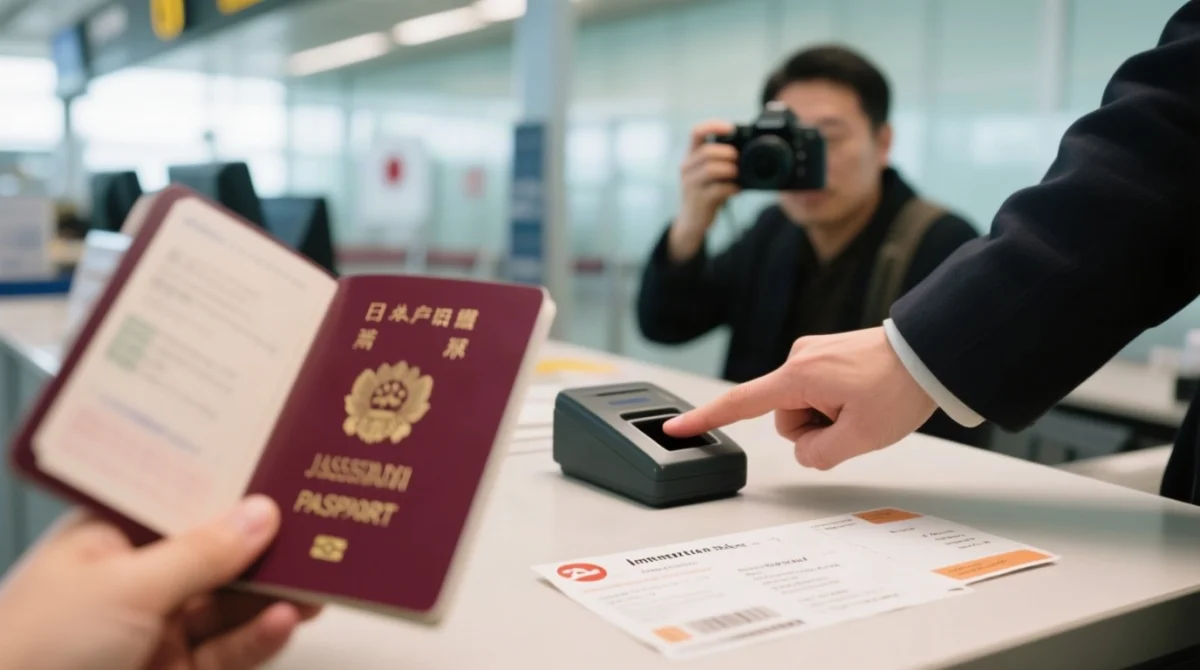
- Biometric data collection: fingerprints and a facial photograph are mandatory for all foreign nationals aged 16+ at the port of entry.
- Typical immigration questions: officers ask about your purpose of visit, intended duration, accommodation address, and return or onward ticket.
- Return ticket: airlines and immigration may request proof of a return or onward journey before granting visa-free entry.
- Sufficient funds: no official minimum threshold exists, but officers may ask British citizens to demonstrate financial self-sufficiency (bank cards, cash, or statements).
- Passport validity: your British Citizen passport must be valid for the entire duration of your intended stay in Japan.
FAQ: Japan Visa Requirements for British Citizens
Do I need travel insurance to enter Japan as a British citizen?
Travel and medical insurance is not legally mandated for British citizens entering Japan. However, the UK Foreign, Commonwealth & Development Office (FCDO) strongly recommends that UK passport holders obtain comprehensive coverage before travelling.
I hold two passports. Which one should I use for Japan?
British citizens with dual nationality should always present their British Citizen passport to benefit from the visa waiver. Japan recognises the nationality of the passport presented at immigration; presenting a non-exempt passport would require UK passport holders to obtain a visa prior to travel.
Can I leave Japan and re-enter to reset my 90 days?
No official 180-day rule exists in Japanese law for British citizens. However, immigration officers may refuse entry to UK passport holders suspected of visa runs to repeatedly reset the 90-day visa-free period. Maintain a genuine travel purpose and sufficient funds.
How much money do I need to show at immigration?
There is no official minimum cash requirement for British citizens entering Japan under the visa waiver. Immigration officers may ask UK passport holders to prove financial self-sufficiency using bank cards, cash, or bank statements showing sufficient funds for the intended stay.
What is JESTA and will it affect British travellers?
JESTA (Japan Electronic System for Travel Authorization) received legislative approval in May 2026 but is not yet operational. The Japanese Ministry of Justice has not published an implementation date. When live, British citizens may need to pre-register online, similar to US ESTA or EU ETIAS. Check GOV.UK FCDO travel advice before booking and before departure.
Can I apply for a Japan eVisa as a British citizen living in the UK?
British citizens cannot apply for a Japan eVisa. The system is for nationals of non-exempt countries residing in Group 1 or Group 2 regions. UK passport holders are visa-exempt for tourism stays up to 90 days and do not need the eVisa.
Is a Certificate of Eligibility (COE) holder still exempt?
British citizens holding a Certificate of Eligibility (COE) must still obtain a visa prior to travel. The COE does not replace a visa for UK passport holders. Even if otherwise visa-exempt, holding a COE requires British citizens to apply for a visa at a Japanese Embassy or Consulate.
Can I do business activities on a visa-free visit?
British citizens can engage in unpaid business activities on a visa-free visit, including meetings, conferences, market research, and lectures. UK passport holders cannot undertake employment, paid consultancy, or recurring business operations under the visa waiver arrangement.
Is the Japan eVisa valid for cruise ship passengers?
Visa-exempt British citizens entering Japan by cruise ship do not need an eVisa. UK passport holders can enter visa-free for tourism. The eVisa permits entry by air and designated ferries, but visa-exempt British citizens are not required to obtain it regardless of entry mode.
Where can I check the latest UK government travel advice for Japan?
British citizens can check the latest UK government travel advice for Japan on the GOV.UK FCDO travel advice page for up-to-date entry requirements, safety, and travel restrictions for UK passport holders.
Before you travel, check: MOFA short-stay visa exemption page (mofa.go.jp) | Embassy of Japan in the UK (uk.emb-japan.go.jp) | GOV.UK FCDO travel advice for Japan. This page may not reflect last-minute changes. Last updated: 9 September 2026. This article is monitored monthly. If you spot a change in Japanese entry rules, contact us and we will issue a correction.