
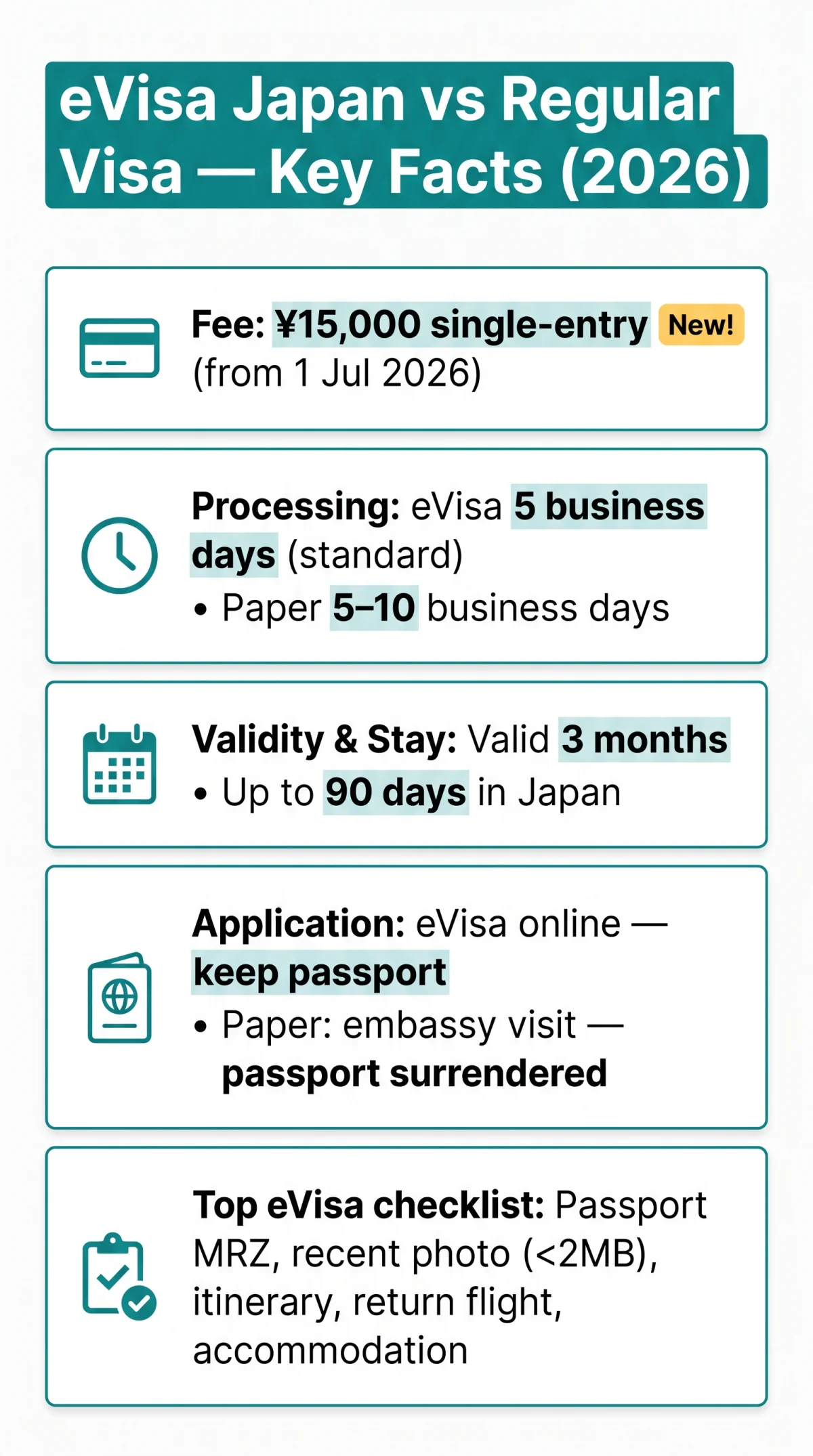
The Japan eVisa and regular paper visa both cost ¥15,000 for single-entry as of July 2026. The eVisa is processed entirely online in approximately 5 business days, while a paper visa requires an in-person appointment at the Embassy of Japan in London. Both permit stays of up to 90 days for tourism. UK passport holders are visa-exempt for stays up to 90 days under visa exemption arrangements with around 70 countries. The primary audience is non-UK nationals residing in the UK (e.g., Indian, Chinese, Filipino passport holders) who require a visa to enter Japan.
What Is the Japan eVisa vs a Regular Paper Visa?
The Japan eVisa is a single-entry short-term stay visa for tourism, permitting stays up to 90 days, issued as an electronic record with no physical sticker. The traditional paper visa is a visa sticker affixed to your passport following an in-person appointment at the Embassy of Japan in London or a consular office with jurisdiction over your residence. The Japan eVisa accepts only an ordinary passport; the traditional paper visa covers all visa types and purposes (business, work, study, family, transit) and all passport categories. The Japan eVisa offers direct online access to UK residents and those in eight other countries. Residents of China, India, the Philippines, and Vietnam must apply through an accredited travel agency. See the MOFA eVisa page (last updated 15 May 2026).
Application Process: Online eVisa vs In-Person Paper Visa
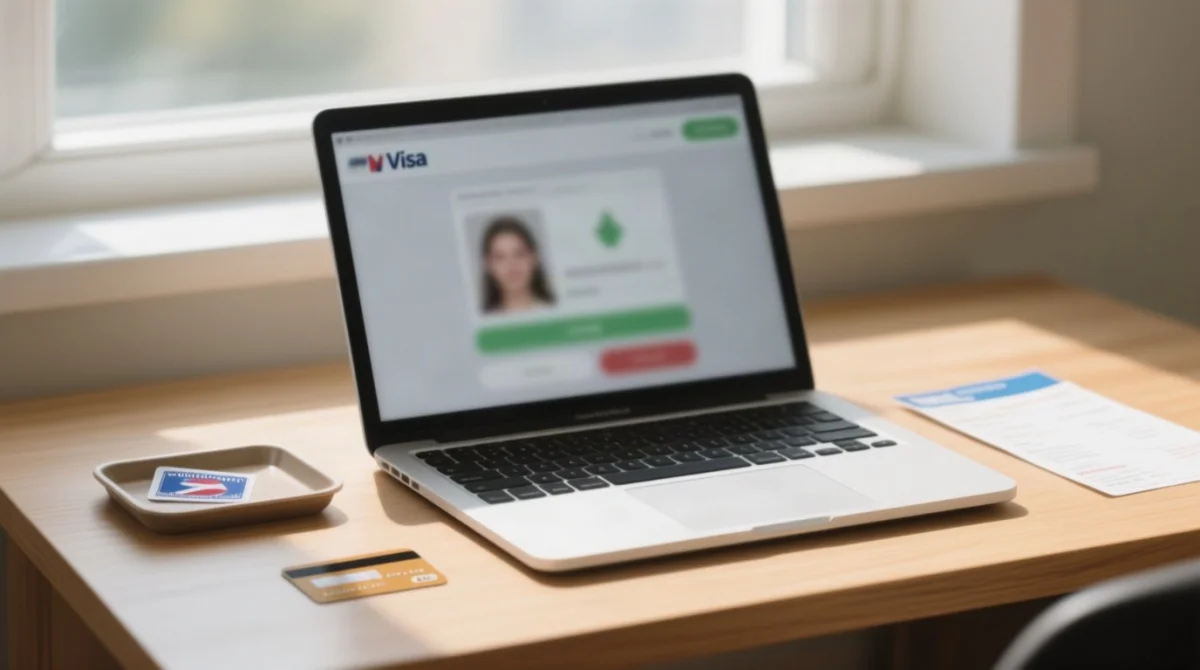
Japan eVisa Application Steps
Create an account
Register on the JAPAN eVISA system and verify your email.
Upload digital documents
Passport scan with MRZ visible (PDF/TIF/JPG/PNG, min 640×480), photo within 6 months (under 2 MB, plain background), daily itinerary, return flight proof, accommodation confirmation.
Pay ¥15,000 by credit card only
The card holder must be the applicant (minors excepted).
Receive the Visa Issuance Notice
Issued electronically. The applicant retains the passport throughout.
Traditional Paper Visa Application Steps
Book an in-person appointment
At the Embassy of Japan in London or the consular office with jurisdiction over your residence. See the Embassy eVisa information page.
Attend in person
Submit original documents plus photocopies.
Pay ¥15,000 by cash or bank transfer
At the consular counter.
Surrender your passport
For visa sticker affixation. Held until processing completes – cannot be used for other travel during that window.
Japan eVisa vs Regular Visa: Side-by-Side Comparison
Both cost ¥15,000 for single-entry as of July 2026 but differ in application, processing, payment, and airport verification. The Japan eVisa allows online applications; the paper visa requires a physical embassy visit.
| Feature | Japan eVisa | Traditional Paper Visa |
|---|---|---|
| Fee | ¥15,000 single / ¥30,000 multiple (from 1 July 2026) | ¥15,000 single / ¥30,000 multiple |
| Processing time | 5 business days standard (over 1 month peak) | 5-10 business days standard |
| Validity | 3 months from issuance | 3 months from issuance |
| Entry type | Single-entry only | Single or multiple |
| Stay duration | Up to 90 days (15/30/90 at consular discretion) | Up to 90 days |
| Application method | Online portal | In-person at embassy |
| Payment method | Credit card only | Cash or bank transfer |
| Document submission | Digital uploads | Originals in person |
| Passport handling | Retained by applicant | Surrendered for visa sticker |
| Extension policy | Cannot be extended | Not specified |
| Purpose | Tourism only | All purposes |
| Airport verification | Live eVISA issuance notice online display | Physical sticker check |
| Passport types | Ordinary only | All types |
| Travel modes | Air + designated ferries | All modes |
| Best for | Short tourist trips from eligible residence countries | All other purposes, long-term stays, or non-eligible countries |
Who Can Apply for the Japan eVisa? Eligibility for UK Residents in 2026
UK residents have direct online access to the Japan eVisa without needing an accredited agency. The direct online group includes 9 countries: Australia, Brazil, Cambodia, Canada, Saudi Arabia, South Africa, Taiwan, United Kingdom, and U.S.A. The accredited agency group covers 10 countries/regions: China, Philippines, Vietnam, Hong Kong, India, Indonesia, Macau, Mongolia, Republic of Korea (excl. Jeju), and UAE. Residents of these countries must apply through a designated travel agency rather than the online portal.
Non-UK nationals should have their Biometric Residence Permit (BRP) as proof of legal residence. Dual nationals of Japan and another country are ineligible. Indian nationals pay a bilateral exception fee of ₹500 when applying in India. Applicants must remain in their country of residence during processing. The traditional paper visa remains the only option for those outside the Japan eVisa eligibility scope.
Documents Needed: Digital vs In-Person Submission
The Japan eVisa requires digital scans submitted online, while the paper visa requires original documents or certified photocopies presented in person. The Japan eVisa accepts files up to 2 MB each; the paper visa accepts physical originals.
eVisa checklist: Ordinary passport scan with MRZ visible (PDF/TIF/JPG/PNG, minimum 640×480), digital photo taken within 6 months (JPG/PNG/GIF/BMP/HEIC, under 2 MB, plain background, face centered, no ID-card crops), detailed daily itinerary, return flight proof, accommodation confirmation for full stay, and proof of financial means. Supporting docs: maximum 50 pages, under 2 MB per file.
Paper visa checklist: Physical passport, passport photocopies, completed application form, printed photos, and supporting originals (invitation letters, employment proof, etc.) submitted at the embassy counter.
eVisa for UK Residents: Fees, Payments, and What You Pay in 2026
Japan’s single-entry visa fee rose to ¥15,000 on 1 July 2026, its first increase since 1978 (48 years). The previous fee was ¥3,000. The multiple-entry fee rose from ¥6,000 to ¥30,000. In GBP, expect approximately £75 to £80 at point of payment (at roughly ¥188 = £1; actual rate depends on card issuer).
The Japan eVisa requires credit card payment only (cash prohibited). The paper visa accepts cash or bank transfer at the consular counter. The Japan eVisa fee is non-refundable even on refusal. Indian nationals applying in India pay a bilateral exception fee of ₹500. The paper visa may incur additional costs: travel to the London Embassy and certified translation fees.
Processing Time: eVisa vs Paper Visa
The Japan eVisa standard processing time is 5 business days from confirmation that the application is complete. During peak travel seasons, processing can exceed 1 month. The traditional paper visa typically takes 5-10 business days as a standard consular processing estimate, and can also be longer during peak periods.
Peak periods include Golden Week (29 Apr-5 May), summer (Jul-Aug), and year-end (20 Dec-5 Jan). No expedited processing is available for either route. Apply exactly 3 months before departure, the earliest allowed window, as both visas carry a 3-month validity from issuance. The stay period of 15/30/90 days is set at consular discretion.
Japan eVisa at the Airport: Arrival Verification and Accepted Ports of Entry
Japan eVisa holders must display the Visa Issuance Notice live on the JAPAN eVISA system using a mobile device with an active internet connection. PDFs, screenshots, and printed copies are strictly rejected at border inspection and immigration clearance. Ensure your phone has Wi-Fi or a data plan at arrival.
The Japan eVisa is accepted at designated airports and seaports for arrivals by air or designated international scheduled ferries between Japan and Busan or Shanghai. Paper visa holders are verified by the physical sticker in their passport. For transfers between non-sterile zones at different airports (e.g., Haneda to Narita), a Shore Pass or Transit Visa may be required. Check the JAPAN eVISA portal for the current list of accepted ports.
Common Mistakes, Refusal Consequences, and Key Tips
A refused Japan eVisa triggers a 6-month reapplication ban with no disclosed reasons and no formal appeal. Common account and document errors can cause avoidable delays.
- Account: Deletion after 365 days inactivity; 5 wrong passwords lock the account for 30 minutes; no edits after submission. Withdrawal only allowed in “Temporarily received” status.
- Document errors: Wrong file type, files over 2 MB, missing MRZ on the passport scan, and photos cropped from ID cards are the most frequent causes of rejection. Passport changes invalidate the Japan eVisa; you must enter with the same passport used for application.
- Refusal consequences: The ¥15,000 fee is non-refundable, no reasons are disclosed by MOFA (Ministry of Foreign Affairs), and there is no formal appeal. This means potential missed flights and rebooking costs.
- Minors: A parent or guardian must submit the Japan eVisa application with consent documentation and civil status certificates. The paper visa requires similar in-person submission for minors.
Frequently Asked Questions: eVisa Japan vs Regular Visa (2026)
Is the Japan eVisa free for UK citizens?
No. The fee is ¥15,000 (approximately £75 to £80 GBP) for single-entry as of July 2026. UK passport holders are visa-exempt for stays up to 90 days and need neither an eVisa nor a paper visa.
How long does the Japan eVisa take to process from the UK?
5 business days standard; over 1 month during peak. Apply 3 months before departure, the earliest allowed window.
Can I use the Japan eVisa at any airport or port?
No. Designated airports and seaports only, for arrivals by air or designated ferries (Japan-Busan, Japan-Shanghai). Check the JAPAN eVISA portal for the current list.
What is the difference between a Japan eVisa and a visa on arrival?
Japan does not offer visa on arrival. Both the eVisa and the traditional paper visa must be obtained prior to entering Japan.
Does the Japan eVisa allow multiple entries?
No. Single-entry only. Multiple-entry requires a regular paper visa at the embassy, costing ¥30,000 as of July 2026.
How long can I stay in Japan with an eVisa?
Up to 90 days. Actual stay (15/30/90 days) is set at consular discretion. The eVisa cannot be extended.
Do I need to surrender my passport for a Japan eVisa?
No. The eVisa is online; you retain your passport. A traditional paper visa requires surrendering your passport for sticker affixation.
What happens if my Japan eVisa application is refused?
6-month wait before reapplying. No reasons disclosed, no formal appeal. The ¥15,000 fee is non-refundable.
Can minors apply for the Japan eVisa independently?
No. A parent or guardian must submit with consent documentation and civil status certificates.
Is a printed copy or screenshot of my Japan eVisa accepted at the airport?
No. Must display the Visa Issuance Notice live on the JAPAN eVISA system. PDFs, screenshots, and printouts are rejected.
eVisa Japan vs regular visa in 2026: Both cost ¥15,000 for a single-entry tourist visa as of July 2026. The eVisa is applied for entirely online in approximately 5 business days, while a paper visa requires an in-person appointment at the Embassy of Japan in London and typically takes longer to process. The eVisa is single-entry, valid for up to 90 days, and accepted only at designated ports of entry.
This is an informational guide, not a government website. For the most accurate and up-to-date information, always check the MOFA eVisa portal. Published: 10 July 2026. Last reviewed: 15 July 2026.