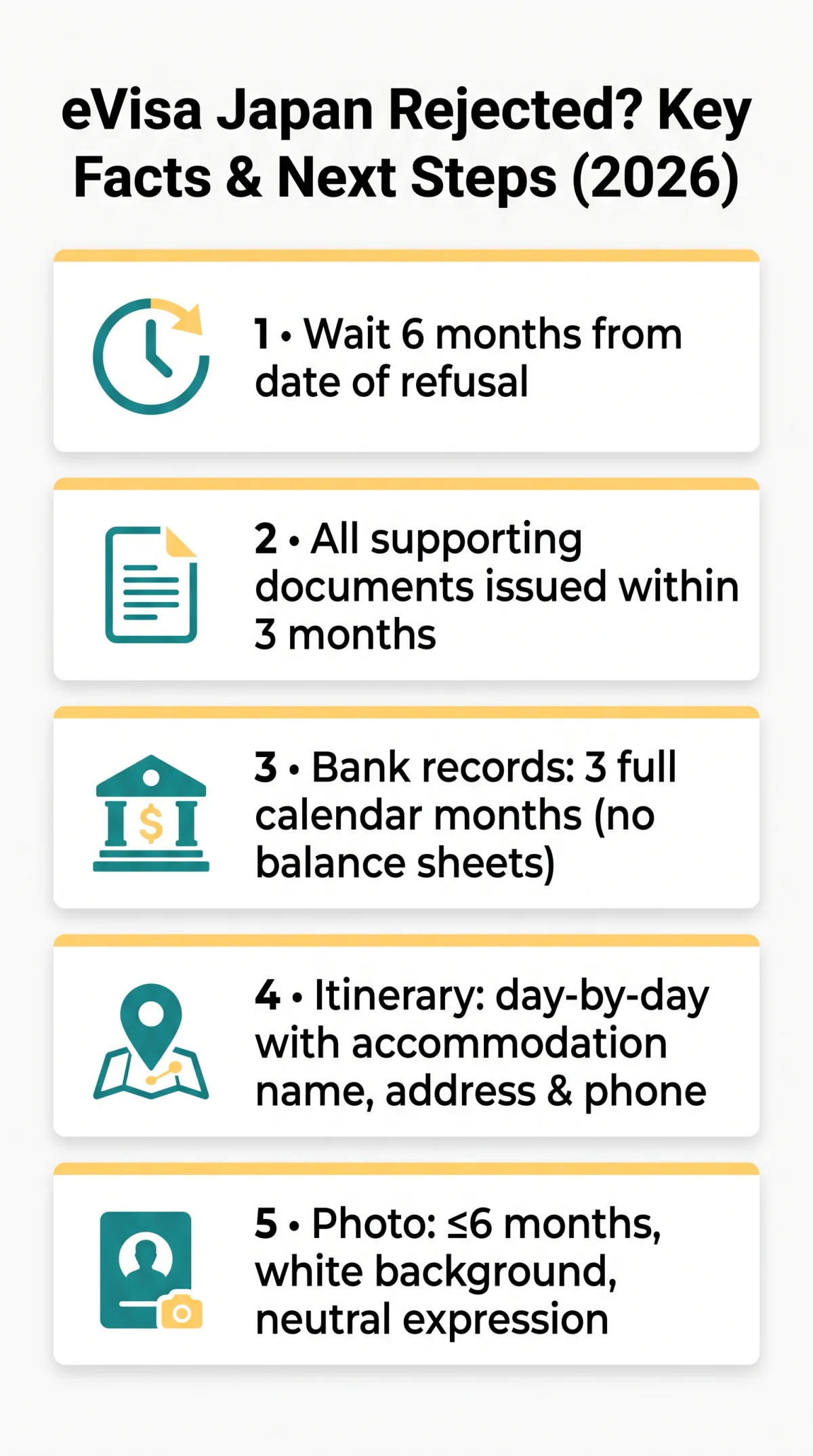
If your eVisa Japan application rejected status appears, the Ministry of Foreign Affairs (MOFA) will not disclose specific refusal reasons under the Administrative Procedure Act, Article 3, Paragraph 1, Item 10. There is no formal appeal process. You must wait six months from the date of refusal before reapplying for the same travel purpose with corrected documents issued within the prior three months.
There is no formal appeal process for a rejected Japan eVisa application in 2026. Instead, you must reapply after the six-month waiting period, ensuring all supporting documents – including detailed daily itineraries and three months of bank statements – are corrected and up to date. Contact the Embassy of Japan in London or the Consulate-General in Edinburgh to confirm which office handles your reapplication based on your UK residence.
Why Was My Japan eVisa Application Rejected?
The Japan eVisa application rejection process begins when immigration authorities determine your submission does not meet visa issuance criteria. Under the Administrative Procedure Act, Article 3, Paragraph 1, Item 10, MOFA does not disclose specific refusal reasons. The most frequent triggers are incomplete documents, insufficient bank records, and vague itineraries.
Incomplete or Incorrect Supporting Documents
Your Schedule of Stay must be day-to-day; vague wording such as “sightseeing” or “day trip” is rejected. All documents must be in English and issued within the last three months. Photos must be taken within 6 months, on a plain white background, with a neutral expression – no filters, no school photos, no photo-of-a-photo. Glasses and hats are prohibited unless medically necessary. Non-applicable form sections must state “NONE” or “NA”.
Insufficient Financial Evidence
Bank records must cover the most recent 3 completed calendar months of transactions – a balance sheet alone is NOT accepted. A statement snapshot ending mid-month is commonly rejected. Credit card records are not accepted at all. Large undocumented bank deposits must be traced with extra documentation showing their source. If your bank issues quarterly statements, request a transaction history covering the full 3-month window.
Weak Travel History or Home Ties
Insufficient proof of ties to home country triggers scrutiny, especially for freelancers whowho must provide extra evidence such as employment letters or property ownership. Inconsistencies with previous travel history, prior overstays, or prior refusals from other countries are flagged during the Japan eVisa application rejection process. Concealment of past immigration violations triggers immediate rejection.
Can You Appeal a Japan eVisa Decision?
No formal appeal process exists for a rejected Japan eVisa. There is no court-style appeal, no review panel, and no option to send an email or letter contesting the decision. Japan’s Administrative Procedure Act, Article 3, Paragraph 1, Item 10 excludes immigration dispositions from the obligation to disclose examination criteria or refusal reasons. According to MOFA’s official visa FAQ (mofa.go.jp/j_info/visit/visa/faq.html, last updated June 2026), refusal notifications do not require disclosure of reasons.
Requesting Reconsideration from the Consulate
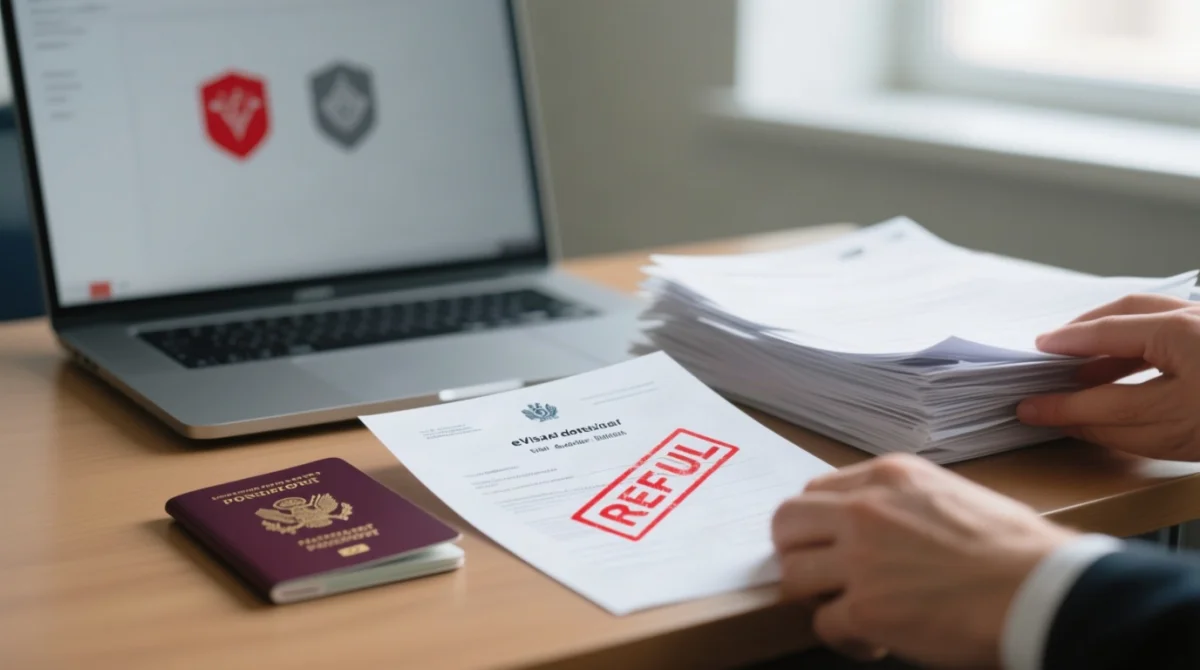
The only informal alternative is to request a manual review from a senior consular officer, providing additional supporting evidence to counter the refusal. Reconsideration is unlikely to succeed without materially new documentation.
Does an eVisa “Cancellation” Count as a Rejection?
“Application Terminated” means the submission was incomplete and processing never began; this may not trigger the six-month reapplication ban. “Cancelled” means the application was processed and refused, which triggers the six-month ban for the same travel purpose. UK applicants who transition to in-person consular submission after an eVisa rejection must know that the six-month ban applies across all channels, online and physical, and jurisdiction shopping between consulates is prohibited.
How to Reapply After a Japan eVisa Rejection
You must wait six months from the date of refusal (not the application date) before reapplying for the same travel purpose. All supporting documents must be freshly issued within the last three months. Submit your new application to the same embassy or consulate that refused you.
Confirm your handling office
Check which UK office handled your original rejection – you cannot switch jurisdictions.
Gather refreshed documents
Collect all updated documents (see checklist below).
Submit to the same office
Send your new application to the same embassy or consulate that refused you.
UK Jurisdiction – Where to Submit Your Reapplication
| Office | Address |
|---|---|
| Embassy of Japan in London | 101-104 Piccadilly, London W1J 7JT |
| Consulate-General of Japan in Edinburgh | 2 Melville Crescent, Edinburgh EH3 7HW |
Jurisdiction depends on your home address postcode. UK residents with BRP or eVisa status must also apply based on their home address postcode. Jurisdiction shopping is prohibited – you must reapply to the same office that issued the rejection. For opening hours and appointment booking, see the official Embassy of Japan in London page (uk.emb-japan.go.jp).
The Six-Month Waiting Period and Exceptions
The 6-month clock starts from the date of refusal, not the application date. The ban applies when reapplying for the same travel purpose. A humanitarian exception exists for serious illness or death of a relative in Japan – but “better documents” or “fixed the problem” alone do NOT qualify. A different visa category is not automatically blocked but faces heightened scrutiny.
Document Checklist After Rejection
- Passport: 6 months validity beyond return date, 2 blank pages, no damage
- Bank records: 3 completed calendar months minimum of transactions (not balance sheets); credit card statements NOT accepted; trace large deposits with source documentation
- Itinerary: day-to-day schedule with accommodation name, address, and phone per day – no vague wording
- Photo: taken within 6 months, passport-sized, white background, neutral expression, no filters
- All documents in English, issued within the last 3 months – do NOT alter documents (cutting/pasting = rejection)
Obtaining Proof of Your eVisa Rejection for Refunds and Records
The eVisa system issues no physical refusal stamp or denial letter. Portal status (“Application Terminated” or “Cancelled”) is your only official digital record – screenshot it; consulates rarely issue written confirmations. The refusal slip returned with your passport does not explain the reason. For airline or hotel refund claims, contact the provider with your booking reference and the portal screenshot.
Japan eVisa Rejection – Your Future Travel Options and Where to Get Help
Japan does not share eVisa refusal data with UK ETA or EU ETIAS systems. MOFA has not published retention periods; prior refusals may be visible for future long-term visa applications. Self-disclose honestly on forms asking about prior refusals.
How a Japan eVisa Refusal May Affect Future UK ETA, ETIAS, and Visa Applications
As of 2026, UK ETA contains no question about Japan visa refusals. However, ETIAS may require disclosure of prior visa refusals when launched. Other countries’ visa forms frequently ask whether you have ever been refused a visa – applicants must self-disclose honestly; concealment can trigger future rejection.
Contacts and Support Resources for Rejected Applicants
Rejected applicants can call FRESC at +81-3-5369-6577 (Mon-Fri 9:00-17:00 JST) for procedural questions, but refusal reasons are not disclosed.
| Service | Contact | Hours |
|---|---|---|
| FRESC Visa Information Line (overseas) | +81-3-5369-6577 | Mon-Fri 9:00-17:00 JST |
| FRESC Visa Information Line (within Japan) | 0570-011000 | Mon-Fri 9:00-17:00 JST |
| MOFA English hotline (U.S.) | 1-202-499-1468 | 24/7 |
| Embassy of Japan in London | 101-104 Piccadilly, London W1J 7JT | Visa section by appointment |
This guide was last checked against MOFA’s official eVisa portal (mofa.go.jp) and the Embassy of Japan in the UK website (uk.emb-japan.go.jp) on 9 September 2026. Japanese immigration rules change frequently; always confirm details with the consulate before applying.
FAQ: Japan eVisa Status, Fees, and Documentation
What does the ‘Application Terminated’ status mean on my Japan eVisa portal?
‘Application Terminated’ means processing never began – the 6-month ban may not apply. ‘Cancelled’ means formal refusal – the 6-month ban applies for the same travel purpose.
Is there an appeal fee for a rejected Japan eVisa application?
No consular issuance fee is charged when a Japan eVisa is rejected. The single-entry fee of approximately 3,000 JPY is only charged upon approval. Agency fees may be non-refundable.
What do the eVisa denial stamp codes A to E mean?
Denial stamp codes A-E are unofficial interpretations, NOT confirmed by MOFA. Do not rely on them; reapplication guidance based on codes is speculative.
Will I be charged a visa fee if my Japan eVisa is rejected?
No consular issuance fee is charged on rejection. Base fees – approximately 3,000 JPY for single-entry, 6,000 JPY for double/multiple-entry, and 700 JPY for transit – are only charged upon approval. U.S. citizens are exempt from these visa fees entirely. Fee amounts reflect historical rates; check the current MOFA fee table before applying.
Do I need a new Certificate of Eligibility (COE) to reapply?
A Certificate of Eligibility (COE) does not guarantee visa issuance. If you are applying for a tourism eVisa, a COE is not required. For student or work visas, check with your educational institution or employer whether your COE needs renewal, especially if the original was issued based on mistaken or fraudulent information.
FAQ: Reapplying After a Japan eVisa Rejection
How long does Japan keep records of my failed eVisa application?
MOFA and the Immigration Services Agency have not published retention periods for failed eVisa applications. Consular records may persist indefinitely, meaning prior refusals might be visible to consular officers reviewing your future long-term work or study visa applications.
Can I reapply for a different visa category immediately after a rejection?
The 6-month ban applies specifically to reapplying for the same travel purpose. A different visa category is not automatically blocked, but it will face heightened scrutiny and additional documentation requests. For example, applying for a student visa after a tourism eVisa rejection is possible but heavily scrutinised.
What if my eVisa was rejected due to a typo or clerical error?
Minor errors like a wrong passport number or date format should not trigger fraud suspicion. If the consulate classifies the error as technical rather than a substantive refusal, they may mark it as ‘Application Terminated’ instead of a formal refusal, meaning the 6-month ban may not apply. You can then reapply with corrected documents.
How long does the Japan eVisa reapplication process take after a rejection?
<5 working days from acceptance if no problems arise. Peak seasons (cherry blossom, Christmas, school holidays) take significantly longer. Tokyo referral cases can take 1-2 months. Expedited service is not available. Submit at least 2 weeks before departure; less than 2 weeks means your application will be returned.
Should I hire a lawyer or immigration consultant after my Japan eVisa was rejected?
For simple cases – incomplete documents or vague itineraries – self-correction and reapplication is sufficient. For complex cases involving prior overstays, criminal records, or misrepresentation allegations, professional help may be warranted. Verify consultant credentials; avoid agents who guarantee approval.